

Cash-Out Multiplier Calculator: Compare 1.5×, 2× and 10× Over a Session
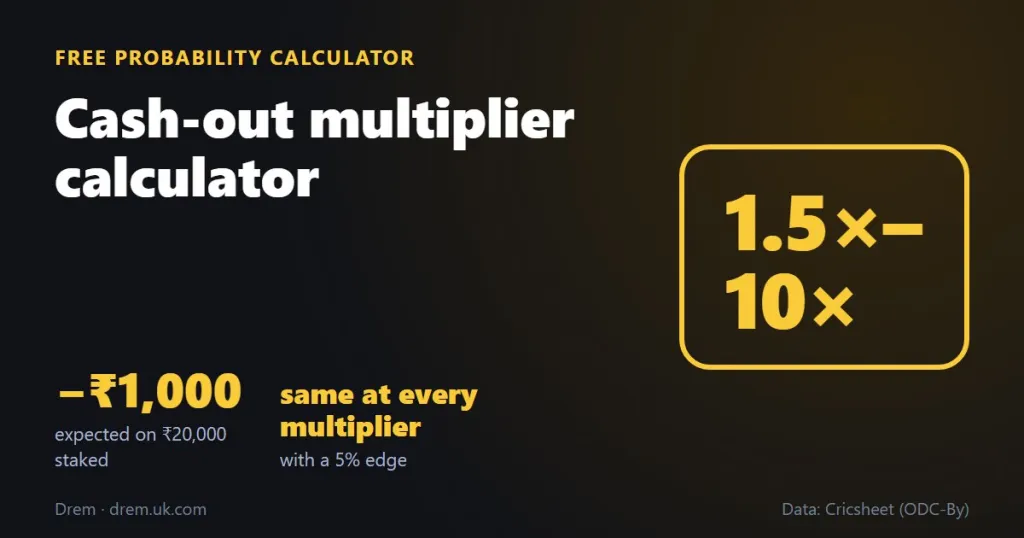
In a crash-style game you choose when to cash out, and the choice feels like skill. This calculator shows what it changes and what it does not. Enter a stake, a multiplier, a house edge and a number of rounds to see the chance of winning a round, the chance of finishing ahead and the expected result, with other multipliers beside yours. It is a model for learning, and it cannot predict a round.
How to use it
- Enter the stake for each round and the multiplier at which you would cash out.
- Enter a house edge. Use the return to player a game states, subtracted from 100. This page assumes no edge for any game on Drem.
- Enter the number of rounds you plan to play.
- Compare the table. Every row has the same expected result, and only the chance of winning changes.
A worked example
Try a ₹200 stake, a 5% edge and 100 rounds. Typing these in and changing the multiplier gives the table below.
| Cash-out | Win per round | Ahead after 100 rounds | Expected result |
|---|---|---|---|
| 1.5× | 63.3% | 25.7% | −₹1,000 |
| 2× | 47.5% | 27.4% | −₹1,000 |
| 5× | 19.0% | 34.3% | −₹1,000 |
| 10× | 9.5% | 35.1% | −₹1,000 |
The last column does not move: ₹1,000 lost on ₹20,000 staked, which is 5%. Choosing a higher multiplier means winning less often for bigger payouts, and the average result does not improve.
How it works
In this model the multiplier at which the round ends is random, and the chance that it reaches m or more is (100% minus the house edge) divided by m. So a 2× cash-out wins just under half the time and a 10× cash-out just under one in ten.
Over a session the number of rounds won follows a binomial distribution, and the session ends ahead when the winnings exceed the stakes. The calculator adds up those exact probabilities, so there is no random simulation and the answer is the same every time.
What it assumes
- Every round is independent of the one before it.
- You use the same stake and the same cash-out every round.
- The edge you type is the only edge. Bonuses, wagering conditions and any real game’s rules are not modelled.
- Nothing here predicts a round or reveals a pattern. If rounds are random, no predictor works.
Choose a limit before you start. The Responsible Gaming page explains deposit and time limits, and the methodology page lists how these models are built.
Real-money gaming is for adults aged 18 and over, and the law where you live may restrict it. Gaming is for fun, not for income. This calculator does not predict results. Limits and warning signs are on the Responsible Gaming page.
This calculator is made by the Drem editorial team. It is not part of the Drem app. It does arithmetic on the figures you type. It does not predict results.