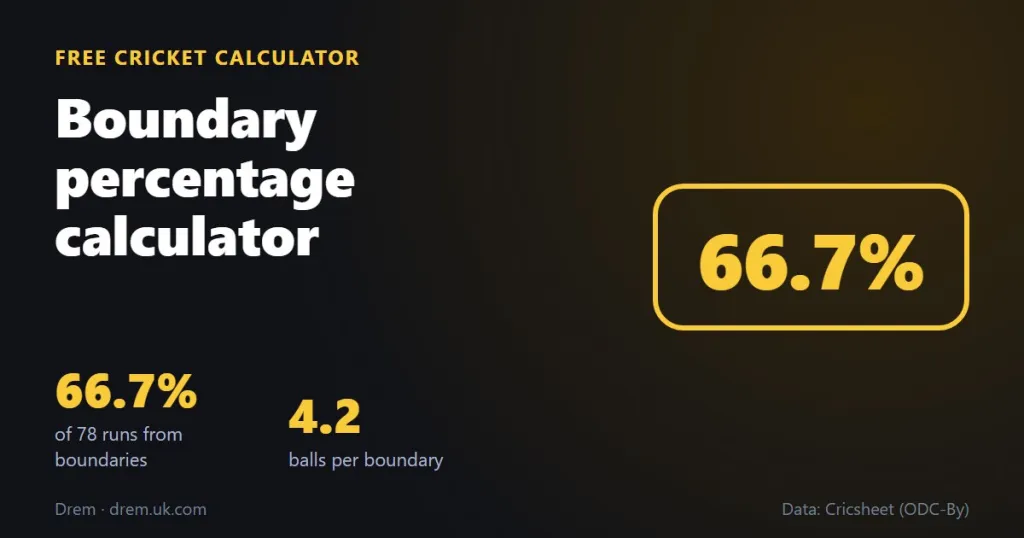
How much of an innings was boundaries, and how much was running? Enter runs, balls faced, fours and sixes and this calculator gives the share of runs that came from boundaries, the balls per boundary and what the batter scored on the other balls. It is free and runs in your browser.
How to use it
Enter the runs scored and the balls faced.
Enter the number of fours and the number of sixes.
Read the boundary share and the balls per boundary.
Read the last two lines: the runs per ball on the balls that were not boundaries, and the overall strike rate.
A worked example
The boxes open with 78 runs from 46 balls, with 7 fours and 4 sixes.
Step
Working
Result
Runs from fours
7 × 4
28
Runs from sixes
4 × 6
24
Boundary runs
28 + 24
52
Share of runs from boundaries
52 ÷ 78
66.7%
Balls per boundary
46 ÷ 11
4.2
Other balls: runs per ball
(78 − 52) ÷ (46 − 11)
0.74
Strike rate
78 ÷ 46 × 100
169.6
How it works
A four is worth 4 runs and a six 6. The boundary share is those runs divided by the total. On the other balls the batter scored the remaining runs, so their rate is the runs left over divided by the balls left over.
Two innings with the same score can have very different shapes. One built on boundaries and dot balls will show a high share and a low rate on the other balls. One built on singles and twos will show the opposite.
What it assumes
Runs entered as fours and sixes count as 4 and 6. Overthrows and other extra runs stay in the other balls.
The tool checks that the boundary runs do not exceed the total and that boundaries do not outnumber the balls.
It describes one innings. It does not say whether the innings was good, because that depends on the match.
To see how the opening overs of an innings are bowled, read the powerplay bowlers report, and to see the other calculators go to the tools list.
This calculator is made by the Drem editorial team. It is not part of the Drem app. It does arithmetic on the figures you type. It does not predict results.
Frequently asked questions
What is a good boundary percentage?
There is no fixed answer. It depends on the pitch, the bowling and the batter’s role. A figure is most useful for comparing two innings of the same player.
What counts as a boundary?
A ball that reaches the rope on the ground (four) or over it (six). Enter the number of fours and sixes. The tool does not separate run fours from boundary fours.
What are “balls per boundary”?
The balls faced divided by the number of fours plus sixes. A lower figure means the batter hit boundaries more often.
Why does the tool show runs per ball on the other balls?
Because it shows how the batter scored when the ball did not reach the rope. It separates innings built on running from innings built on hitting.